








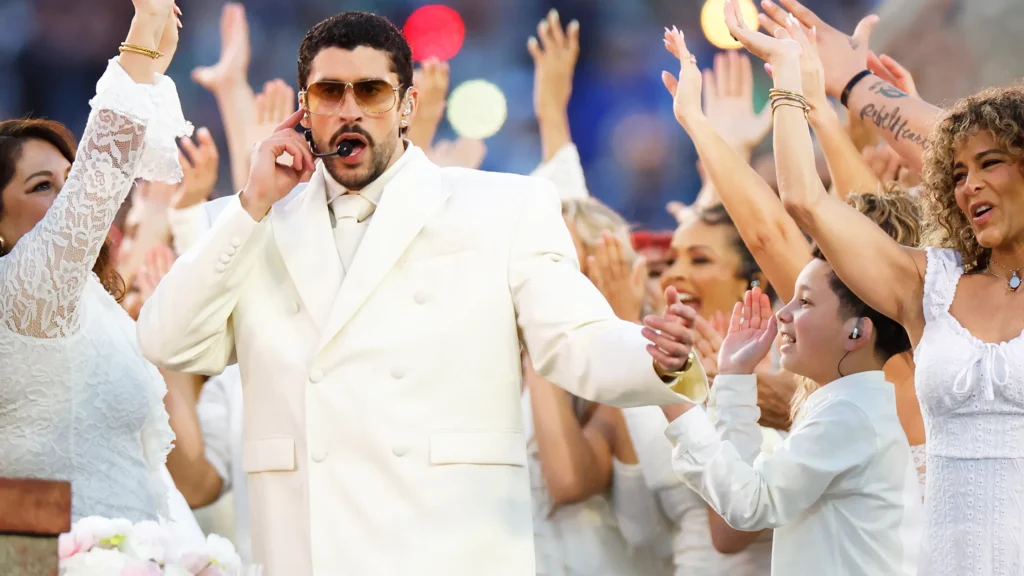
Yet the halftime performance did not emerge in a vacuum. Super Bowl LX itself had already taken shape as one of the most politically and culturally loaded editions of the event in recent memory. In the weeks leading up to kickoff, debates surrounding immigration enforcement, cultural representation, and political polarization had increasingly overlapped with the media buildup to the game. While the halftime show ultimately dominated public discussion, the championship match itself — played before a global audience — delivered a controlled, physical, and tactically disciplined contest that gave the night its competitive backbone.
Beyond the spectacle and controversy, the sporting stakes were real and substantial. Played at Levi’s Stadium in California before tens of thousands of spectators and a television audience exceeding one hundred million viewers worldwide, the final brought together two franchises with sharply different seasonal trajectories. Seattle arrived with a reputation for defensive rigor, structured play-calling, and tempo control. New England entered with a younger, faster-evolving roster and an identity built on aggressive rebuilding and tactical risk. The contrast in styles shaped expectations before kickoff and defined the rhythm once the game began. The final score — 29–13 in favor of Seattle — reflected not dominance through spectacle, but superiority through structure and execution.
An Artist of Open Political Confrontation
Bad Bunny — born Benito Antonio Martínez Ocasio in Puerto Rico — has built his global career not only on musical innovation but also on visible political engagement. His public positions in defense of migrants, LGBTQIA+ communities, and women’s rights have positioned him among the most openly political mainstream artists of his generation. His criticism of Donald Trump’s policies has been explicit and repeated, extending across interviews, performances, and visual projects. As a result, he has become not merely an entertainer but a symbolic figure within broader protest cultures across the Americas.

Bad Bunny delivered the traditional Super Bowl halftime show Sunday night. (Credit: Getty Images)
His recent creative work illustrates this strategy of symbolic confrontation. The release of the music video for his song Nuevayol was deliberately scheduled for July 4, 2025 — the anniversary of the United States Declaration of Independence — transforming a national holiday into a platform for counter-narrative imagery. The video features the Statue of Liberty draped in a Puerto Rican flag, invoking the 1977 protest in which activists climbed the monument to assert Puerto Rican sovereignty claims. The imagery blends historical memory with contemporary identity politics, linking colonial history, migration, and belonging.
In another sequence, young Latino characters listen to an AI-generated speech in Donald Trump’s voice apologizing to immigrants and recognizing their foundational role in the country. The use of artificial intelligence adds another layer: technological simulation used to produce political reversal — satire functioning as critique.
A Politicized Super Bowl Before Kickoff
Controversy began well before halftime. The announcement of Bad Bunny as headliner triggered strong reactions across conservative political media. Critics questioned both the linguistic and cultural legitimacy of a Spanish-language performer occupying what they described as America’s most symbolic entertainment stage. Commentators framed the choice as ideological rather than artistic. Political figures amplified the criticism, transforming a programming decision into a partisan talking point.
Donald Trump himself reacted on social media, writing that the halftime choice was “absolutely ridiculous,” a message that quickly spread across both political and sports news coverage.
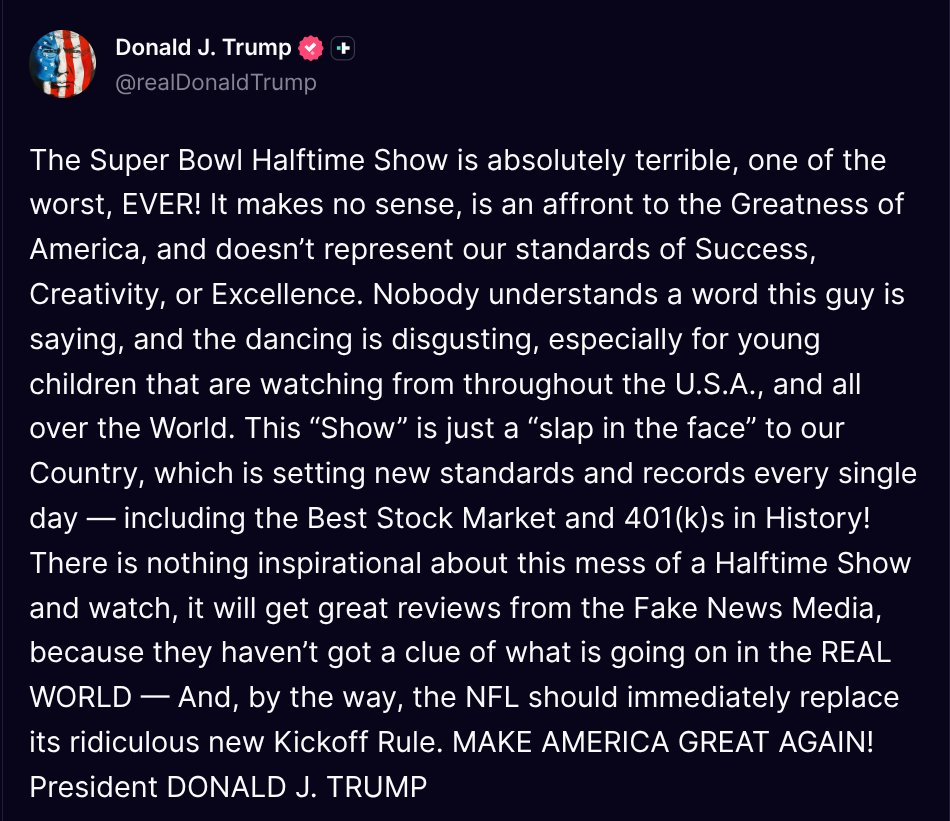
Post by Donald Trump on Truth Social.
Security announcements further politicized the atmosphere. Immigration enforcement presence around the stadium was publicly emphasized, adding a layer of institutional tension to an already polarized climate. The symbolic collision was clear: a performer associated with migrant advocacy appearing on a stage surrounded by visible state enforcement structures.
A conservative counter-event was organized as an alternative patriotic show, explicitly positioned against the halftime performance. The audience disparity between the two events highlighted the difference between symbolic resistance and mass cultural reach — the Super Bowl broadcast remained overwhelmingly dominant.
A Game Defined by Control, Pressure, and Field Position
Amid the surrounding debate, the game itself unfolded with a very different logic — one of discipline, patience, and tactical control. Rather than becoming an offensive spectacle, the match developed as a strategic duel shaped by defense, territory, and possession time. Seattle established control early through field position management and defensive pressure schemes that limited New England’s passing comfort.
The first half progressed through repeated defensive stands and incremental scoring advances. Seattle accumulated points through sustained drives and reliable kicking rather than explosive breakthroughs. The pace favored the team most comfortable with structured progression and clock control.
New England struggled to stabilize offensive rhythm under continuous pressure. Passing windows narrowed, decision time shortened, and deeper route development was repeatedly disrupted. Adjustments after halftime improved movement but did not fundamentally alter momentum.
The decisive phase came in the fourth quarter, when a scoring drive followed by a defensive turnover converted into points created a gap too wide to close. From that moment, the competitive uncertainty that defines classic Super Bowls gave way to controlled closure.
Individual performances reinforced the structural story of the game: effective rushing production, defensive disruption, low-risk quarterback management, and conversion efficiency. The contrast between Seattle’s executional consistency and New England’s fragmented drives explained the result more clearly than any single highlight play.
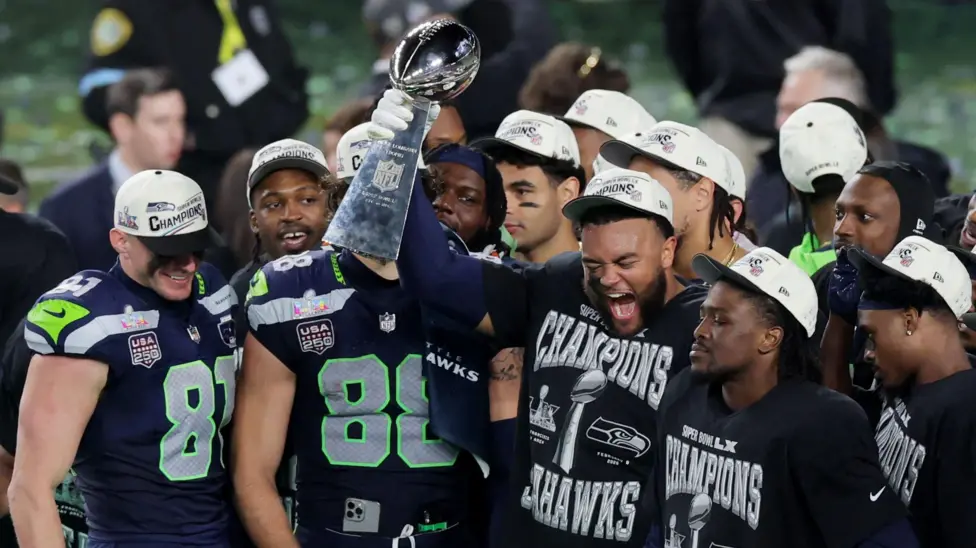
Seattle lifts the Lombardi Trophy after defeating New England 29–13 in Super Bowl LX.
A Stadium Between Ritual and Tension
Inside the stadium, the sensory experience followed the ritual grammar of the Super Bowl: choreographed ceremonies, celebrity sightings, anthem performances, synchronized visuals, and broadcast precision engineered for maximum global impact. Yet surrounding this familiar spectacle was an unusually visible security and political context. Pre-game discourse included protest scenarios, enforcement posture, and symbolic interpretation — elements rarely foregrounded in earlier editions.
This duality — ritual celebration within, political tension without — heightened interpretive sensitivity around every symbolic gesture that followed, especially during halftime.
Choosing Silence as Political Language
Contrary to expectations of direct confrontation, Bad Bunny’s halftime performance avoided explicit political speech. The restraint itself became the message. Where critics anticipated slogans, he delivered staging. Where confrontation was expected, he presented representation.
The set design reconstructed Puerto Rican urban life — homes, streets, color, community scenes — transforming the field into a cultural landscape rather than a neutral stage. Spanish-language performance dominated without translation or concession. Cultural presence functioned as political assertion.
The inclusion of Latin and diaspora figures reinforced collective identity rather than individual protest. The performance did not argue — it displayed. It did not accuse — it affirmed.
The closing gesture — raising a football marked “Together we are America” — condensed the message into a single symbolic frame linking sport, belonging, and plural identity.
More Than a Championship Night
The aftermath demonstrated how far the Super Bowl has evolved beyond sport alone. Public reaction concentrated less on tactical analysis than on cultural interpretation. Media coverage split between match evaluation and symbolic decoding. Digital discourse amplified identity narratives over statistical breakdowns.
Super Bowl LX will be remembered not only for its final score, but for its layered meaning — a championship decided through discipline, a halftime show interpreted through politics, and a national spectacle reflecting social division and cultural plurality at once. The scoreboard delivered a winner. The stage delivered a statement. Together, they transformed a sporting final into a moment of broader historical resonance.


