
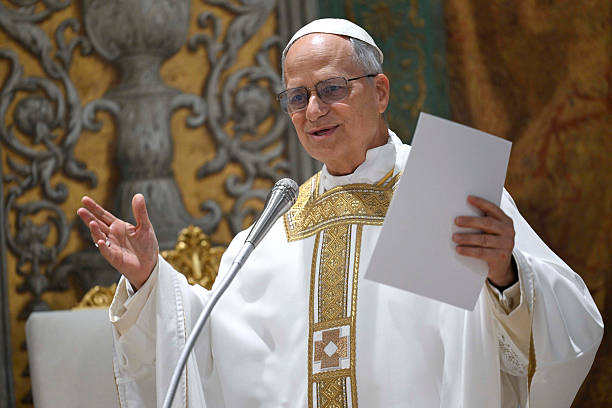
A Message to the World, Calling for Peace and Solidarity
Thousands of faithful gathered in St. Peter’s Square on Sunday to hear Pope Leo XIV deliver his first Easter Mass as the Pontiff. The head of the Catholic Church called for dialogue and urged those with the power to unleash wars to instead choose peace. His message is followed not only by believers, but also by political leaders and the media, giving his words resonance that extends far beyond the religious sphere.
In a context marked by international conflicts, geopolitical tensions, and deepening social crises, his message takes on broader global significance. At a time when multiple regions of the world are facing instability, the Pope’s call for peace positions him as a moral voice attempting to transcend political divides.
Speaking from the central balcony, framed by white roses, he said: “Let us abandon every desire for conflict, domination, and power, and implore the Lord to grant his peace to a world ravaged by wars and marked by a hatred and indifference that makes us feel powerless in the face of evil.”
In his message, Leo XIV echoed the late Pope Francis’ phrase about the “globalization of indifference,” acknowledging that “we are growing accustomed to violence, resigning ourselves to it and becoming indifferent to the deaths of thousands of people.” In doing so, he highlighted a growing concern within the Catholic Church about the normalization of conflict in global public opinion.
“Let those who have weapons lay them down. Let those who have the power to unleash wars choose peace. Not a peace imposed by force, but through dialogue. Not with the desire to dominate others, but to encounter them,” the pontiff added.
The Vatican’s Active Role in Global Conflicts
After delivering his message, the Pope extended Easter greetings in several languages, including Latin, Chinese, and Arabic. He concluded with the traditional Urbi et Orbi blessing, meaning “To the City and to the World,” symbolically addressing both Rome and the international community.
Beyond this ceremonial dimension, the Vatican continues to position itself as an active moral actor in global affairs. On Good Friday, Leo XIV carried the cross during the Via Crucis at the Colosseum in Rome. During the ceremony, the faithful heard prayers for deported immigrant children, alongside a warning to world leaders that their actions will ultimately be judged.
Similarly, during Saturday night’s Easter Vigil, he urged believers not to become numb to the scale of global conflicts, but rather to remain engaged and work actively toward reconciliation. In a more direct political message, he addressed Donald Trump, urging him to de-escalate tensions with Iran.
Overall, Pope Leo XIV has adopted an approach centered on maintaining hope in the face of war, climate change, and widespread human suffering, while consistently promoting dialogue and cooperation among nations. His interventions reflect a broader effort by the Vatican to remain relevant in an increasingly fragmented and unstable international context.
An International Influence with Diplomatic Reach
Beyond his words in the Vatican, Pope Leo XIV has reinforced his global influence through strategic visits and symbolic gestures across regions marked by conflict and political tension. His travels are not merely pastoral, but carry clear geopolitical weight, positioning the Holy See as a diplomatic actor on the world stage. Through these visits, the Pope seeks not only to support local populations, but also to send broader political signals in favor of dialogue, stability, and cooperation.
During his first international trip in late 2025, the Pontiff chose to visit Turkey and Lebanon, a decision that immediately highlighted the diplomatic orientation of his papacy. In Turkey, he engaged with both political authorities and religious leaders, emphasizing the importance of interreligious dialogue in a region shaped by complex historical and geopolitical tensions. This visit underscored the Vatican’s longstanding role as a mediator capable of fostering communication between different faiths and political actors.
He then traveled to Lebanon, a country deeply affected by internal divisions and regional instability. There, he met with political leaders and representatives of various religious communities, and delivered strong messages calling for peace, national unity, and an end to hostilities. Through public addresses and religious ceremonies, he expressed support for the Lebanese population while reaffirming the importance of coexistence in a fragile political environment. This stage of the trip illustrated how the Vatican combines spiritual authority with a form of discreet but meaningful diplomatic engagement.
Looking ahead, the continuation of such visits is likely to reflect both the geographical priorities of the Catholic world and the Vatican’s strategic interest in regions facing political, social, or economic challenges. Countries in Latin America, Africa, and potentially North America could constitute key destinations in the coming years. While no official schedule has been fully confirmed, these potential travels would further reinforce the Holy See’s role in promoting dialogue and stability at the international level, particularly through symbolic diplomacy rather than direct political intervention.
Is the Holy See Making a Comeback on the World Stage?
Ultimately, in an increasingly fragmented world, where political divisions and armed conflicts continue to deepen, the messages of global leaders tend to transcend national boundaries. Without military or economic power, the Holy See exerts influence through moral authority and global visibility, shaping international conversations beyond traditional diplomacy, whether through words, symbolic acts, or strategic visits.
At the same time, the Pope’s role highlights both the limits and the possibilities of moral authority in global politics. While he cannot enforce decisions or impose solutions, his interventions can shape public discourse, influence diplomatic agendas, and place humanitarian concerns at the center of international attention. In this sense, his leadership stands in contrast to traditional power structures, relying instead on persuasion and ethical appeal.
In a time marked by indifference and instability, the Pope’s message serves as a reminder that dialogue and reconciliation remain essential. While its concrete impact may be difficult to measure, this moral voice continues to play a role in framing global debates and keeping humanitarian concerns at the forefront of international relations.
Ultimately, the growing visibility of Pope Leo XIV on the international stage reflects a broader evolution of global leadership, where influence is no longer solely defined by military or economic power, but also by the ability to shape narratives and mobilize public opinion. In this context, the Holy See’s role, though limited in its means, remains significant in promoting dialogue and keeping the question of peace at the center of global attention.

