






A Strategic Summit to Reassert U.S. Influence in the Americas
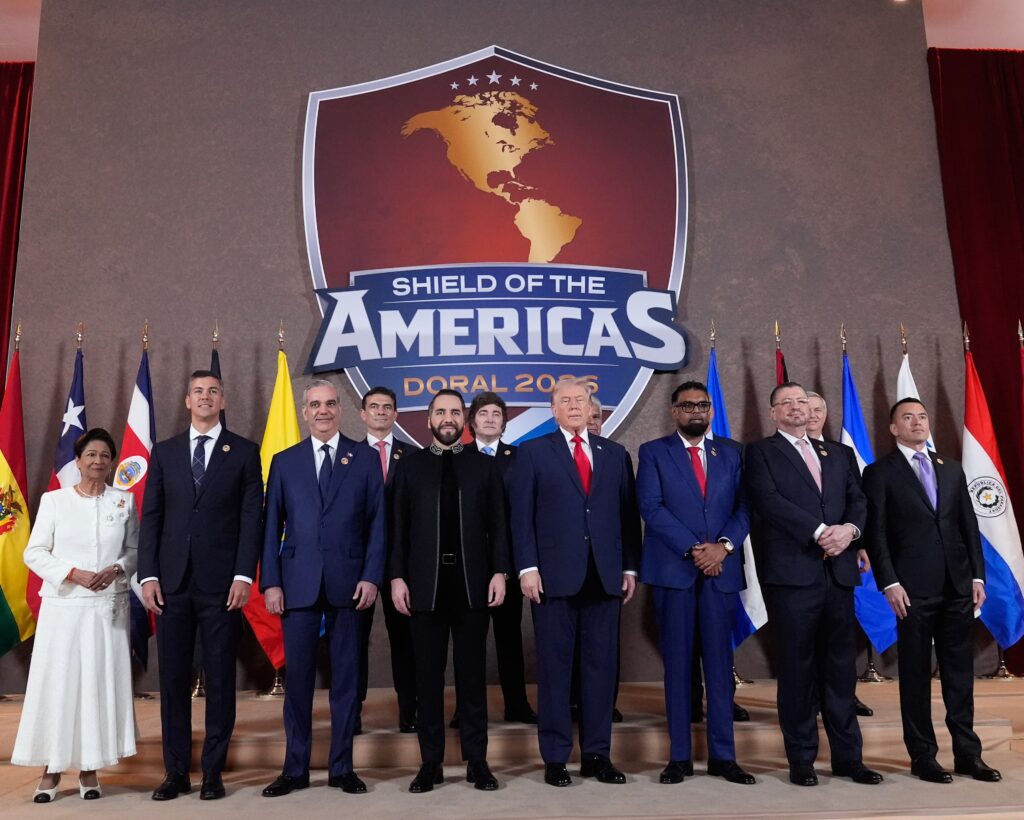
On March 7, 2026, the United States organized the “Shield of the Americas” conference in Florida, bringing together like-minded allies in the Western Hemisphere to promote freedom, security, and prosperity in the region. Among the invited countries were Argentina, El Salvador, and Ecuador. Notably absent were the leaders of Brazil, Mexico, Colombia, and Canada—some of the continent’s largest economies, highlighting existing political and strategic divisions within the region.
This coalition aims to develop coordinated strategies to curb foreign interference in the hemisphere, combat organized crime and drug trafficking, and address illegal immigration. It also reflects Washington’s growing concern over transnational threats and its desire to reinforce security cooperation with regional partners.
However, beyond these official objectives, experts argue that the summit primarily served as a platform to address a broader geopolitical challenge: the rise of Chinese influence in Latin America. Over the past decade, many countries in the region have strengthened their trade and investment ties with China, particularly Chile, Bolivia, and Panama. In this context, the initiative can be seen as part of a wider U.S. strategy to reassert its leadership and limit Beijing’s expanding economic and strategic footprint in the hemisphere.
A Return to Sphere-of-Influence Politics?
The Monroe Doctrine, proclaimed in 1823, is often summarized by the principle “America for Americans.” Originally designed to deter European intervention in the Western Hemisphere, it established the idea that the region should remain free from external interference and under U.S. strategic influence. Over time, however, it has frequently been reinterpreted as a doctrine justifying American dominance and intervention in Latin America.
In this context, recent U.S. initiatives appear to reflect a revival—at least in spirit—of this historical framework. According to Donald Trump, the region had been neglected by the United States for many years. He argued that Washington is now seeking to rebuild its influence by forming a “common shield” aimed at promoting shared priorities and restoring stability in the hemisphere.
The Republican president also reiterated his long-standing rhetoric portraying the region as facing serious challenges related to drug trafficking and violence, warning that “most of the drugs enter through Mexico.” In previous years, U.S. officials frequently pointed to Venezuela as a key source of regional instability, reinforcing a narrative that frames Latin America primarily through security concerns.
Taken together, these elements suggest a shift toward a more assertive U.S. posture in the hemisphere—one that prioritizes control over strategic space, security cooperation, and geopolitical competition, particularly in response to external actors such as China.
Security, Migration, and Geopolitics: The Core Priorities of the Summit
One of the central objectives of the summit is to combat drug trafficking and transnational criminal organizations, with participating countries agreeing to enhance intelligence sharing and coordinate security and military operations against cartels. U.S. President Donald Trump emphasized a hardline approach, arguing that the most effective strategy is stronger military cooperation, stating that countries must “use the power of our militaries” to dismantle criminal networks. This reflects a broader shift toward securitized responses to transnational threats in the region.
Another key priority discussed at the summit was illegal migration. The initiative promotes closer collaboration on border security, migration management, and regional policing strategies. According to Kristi Noem, appointed as special envoy to the initiative, the objective is to foster “freedom, security, and prosperity in our region” while supporting neighboring countries in strengthening their border control and institutional capacities. This approach highlights the increasing linkage between migration and security in U.S. regional policy.
Beyond these immediate concerns, the summit also reflects a broader geopolitical reconfiguration in the Western Hemisphere. U.S. officials stressed the need to reduce China’s influence in Latin America, particularly in strategic sectors such as trade, infrastructure, and investment. In this sense, the coalition is not merely a security initiative but part of a wider effort to reshape the regional balance of power and reassert U.S. leadership in response to growing global competition.
Diverging Responses Across Latin America
On Sunday, March 8, Mexican President Claudia Sheinbaum responded cautiously to Donald Trump’s statements, declaring: “Monday calmly, cool head.” When questioned again the following day, she reaffirmed Mexico’s opposition to any form of military intervention on its territory and expressed support for cooperation based on intelligence sharing and security coordination. “And we proudly continue to say ‘no’,” she stated, underscoring Mexico’s commitment to an autonomous foreign policy and its reluctance to align fully with U.S.-led security strategies.
Colombian President Gustavo Petro also voiced strong criticism on Monday, March 9, particularly regarding his country’s exclusion from the alliance. “In the case of cocaine, Colombia is essential because of its experience,” he argued. While he did not reject the idea of political coalitions, he questioned their effectiveness, stating that “with 17 small, weak, and inexperienced countries, you can’t make a shield against the mafias.” His remarks highlight concerns about both the legitimacy and the operational capacity of the initiative.
In contrast, Ecuador’s president, Daniel Noboa, adopted a more supportive stance, emphasizing the importance of regional cooperation in confronting transnational criminal networks. He stressed that security should be treated as a shared priority and that “ideological differences should not prevent countries from working together against organized crime.” His position reflects a willingness among some governments to engage more closely with U.S.-led initiatives in pursuit of stability.
Taken together, these reactions illustrate a fragmented regional landscape, where cooperation remains uneven and often shaped by domestic political considerations as well as differing perceptions of security and sovereignty.
A Fragmented Hemisphere in a Competitive Global Order
One key question that arises is who sets the regional agenda—and with what strategic objectives. As Latin America continues to face challenges in developing its own infrastructure, expanding intra-regional trade, and coordinating a common foreign policy toward major global powers such as China, the United States, and Europe, it risks once again becoming shaped by external strategies rather than its own priorities.
In this context, the “Shield of the Americas” can be interpreted both as a legitimate security initiative and as a clear signal that Washington does not intend to retreat from its influence in the hemisphere. While the initiative aims to address pressing issues such as organized crime and migration, it also reflects broader geopolitical ambitions tied to maintaining strategic dominance in a region increasingly contested by global powers.
In a global environment where trade routes, critical minerals, ports, and security interests are deeply interconnected, the stakes extend far beyond U.S.-China rivalry. The real challenge lies in Latin America’s capacity to assert its autonomy and define its own development and security strategies.
Ultimately, the “Shield of the Americas” highlights both the opportunities and the limits of regional cooperation. While it may strengthen coordination on security issues, it also exposes underlying divisions and asymmetries within the hemisphere. The future of the region will depend not only on external initiatives but also on the ability of Latin American countries to build cohesive strategies, reduce dependency, and act as unified actors on the global stage. Without such efforts, the region risks remaining a space where global powers compete rather than becoming a central player shaping its own destiny.

