

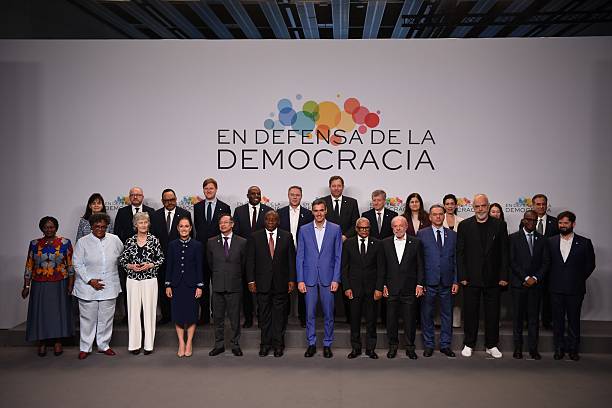
The fourth “In Defense of Democracy” meeting was held on Saturday, April 18, in Barcelona, Spain, bringing together heads of state and progressive leaders from Latin America and beyond. Among the most prominent participants were Spanish Prime Minister Pedro Sánchez, Mexican President Claudia Sheinbaum, Brazilian President Luiz Inácio Lula da Silva, Colombian President Gustavo Petro, Uruguayan President Yamandú Orsi, and former Chilean President Gabriel Boric.
Although the summit was formally centered on the defense of democracy, discussions quickly moved beyond that framework. Leaders used the meeting to address a broader set of international issues, including reform of the United Nations, the humanitarian and political situation in Cuba under the United States embargo, and the wider challenges facing multilateral cooperation in an increasingly polarized global environment. More broadly, the gathering reflected an effort by progressive leaders to articulate a common political position at a time of geopolitical uncertainty and growing ideological divisions.
Leaders Call for Reform of the United Nations
One of the main themes of the summit was criticism of the current functioning of the United Nations. Brazilian President Luiz Inácio Lula da Silva was among the strongest voices on the issue. “The UN cannot remain silent and watch what is happening in the world,” he said, arguing that the organization no longer fully serves the purpose for which it was created. He also denounced the UN Security Council for allowing what he described as unilateral decisions to prevail without broader international participation.
Created in 1945, the United Nations was designed to promote peace, security, and international cooperation in the aftermath of the Second World War. At the heart of its security architecture is the Security Council, which is responsible for maintaining international peace and security. It has 15 members, including five permanent ones — China, France, Russia, the United Kingdom, and the United States — all of which hold veto power. This mechanism allows any one of those states to block a resolution, even when it has majority support, and has long been criticized for concentrating power in the hands of a few countries while limiting the organization’s ability to respond effectively in times of crisis.
Spanish Prime Minister Pedro Sánchez also called for institutional reform and argued that the next Secretary-General of the United Nations should be a woman once António Guterres’ term comes to an end. Such an appointment would mark a historic first for the organization. Former Chilean President Gabriel Boric supported the proposal, insisting that the moment had come for the UN to be led by a woman for the first time in its history. He described it as both a symbolic and political opportunity for the institution to embody the change it often calls for globally.
Taken together, these interventions reflected a broader dissatisfaction with the structure of global governance. For the leaders gathered in Barcelona, the issue was not only the functioning of the UN itself, but also the question of whether international institutions remain capable of responding to contemporary crises with legitimacy and effectiveness.
Calls Grow to End Cuba Blockade at Summit
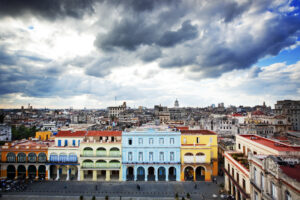
Cuba also emerged as a major topic during the summit. Mexican President Claudia Sheinbaum used the meeting to call for a declaration opposing any form of military intervention in Cuba. “Let dialogue and peace prevail,” she said, while also reaffirming Mexico’s longstanding opposition to the United States embargo. She recalled that Mexico has maintained support for Cuba since 1962, at a time when many other governments chose silence or alignment with Washington’s position.
Mexico’s stance is part of a long diplomatic tradition. Unlike many countries in the region, it has historically maintained relations with Havana and, in recent years, has continued to send humanitarian assistance to the island as economic conditions worsened. In Barcelona, the Cuban issue was framed not only as a bilateral concern, but as a broader symbol of unequal power relations in the international system and of the limits of collective action in the face of prolonged sanctions.
Lula da Silva echoed these concerns in strong terms, calling for an end to what he referred to as the “blockade.” In his closing speech, he argued that the Cuban people should be allowed to live freely and without external pressure. His remarks reinforced the summit’s broader criticism of selective international responses to humanitarian and political crises.
Later, the governments of Brazil, Spain, and Mexico issued a joint statement pledging to coordinate increased humanitarian assistance for the Cuban population. This commitment gave concrete form to the declarations made during the summit and suggested that the meeting sought not only to produce symbolic political messages, but also to encourage limited forms of coordinated action.
Mexico-Spain Relations Mark a Rapprochement
Sheinbaum’s participation in the summit also carried bilateral significance. It marked her first visit to Spain since taking office and appeared to signal a normalization of diplomatic relations between the two countries after several years of tensions over historical memory and the legacy of the Spanish conquest of the Americas.
An early sign of this shift had come in March, when King Felipe VI acknowledged past abuses committed during the conquest. His remarks followed repeated requests from Mexico for Spain to address that historical legacy more openly. Those demands had first been raised under former President Andrés Manuel López Obrador and were later maintained under Sheinbaum. Although the issue created diplomatic friction, it never led to a full rupture in relations.
During the summit, Sheinbaum rejected the idea that there was an ongoing diplomatic crisis between Mexico and Spain, insisting that there never truly had been one. At the same time, she emphasized the importance of recognizing the endurance and historical strength of Mexico’s Indigenous peoples. Her comments suggested a desire to move beyond confrontation without abandoning the symbolic and political issues that had shaped recent tensions.
Sheinbaum also proposed that Mexico host the fifth “In Defense of Democracy” meeting in 2027. After the summit, she held a bilateral meeting with Sánchez, during which they discussed both the historical legacy of the conquest and renewed forms of cooperation between their two countries. Sánchez later wrote on X that they had discussed global challenges as well as EU-Mexico relations, and welcomed the prospect of Mexico hosting the next edition of the summit.
This sequence of exchanges gave the meeting an additional diplomatic layer. Beyond the multilateral agenda, Barcelona also served as a space for bilateral rapprochement, showing how such summits can function simultaneously as forums for ideological positioning and as opportunities for strategic diplomatic repair.
A Political Signal amid Global Tensions
The summit also carried a broader political meaning. Upon arriving at the meeting, Colombian President Gustavo Petro was asked by journalists whether the gathering was an “anti-Trump summit.” He rejected that characterization, describing it instead as an attempt to put forward an alternative vision for the world. He called it “a kind of lighthouse in the midst of confusion and global disorder,” one that points toward life rather than destruction.
His remarks captured the larger spirit of the event. At a time marked by the rise of right-wing movements, increasing global polarization, and renewed uncertainty about the future of multilateral institutions, the meeting in Barcelona appeared to serve as a moment of regrouping for progressive leaders. It was not simply a diplomatic encounter, but also a political signal — an effort to demonstrate unity, coordination, and ideological coherence in an international environment defined by fragmentation.
The presence of both Latin American and European leaders reinforced this message. It suggested an attempt to build a shared political narrative that extends beyond regional boundaries and links domestic democratic concerns to broader questions of global order. The summit projected an alternative reading of international affairs, centered on cooperation, multilateralism, social justice, and institutional reform.
At the same time, the meeting highlighted the limits and ambiguities of such efforts. While the rhetoric of unity was strong, the leaders involved represent different national interests, political traditions, and strategic priorities. The significance of the summit therefore lies less in the immediate adoption of a common agenda than in its symbolic effort to shape a collective progressive discourse at the international level.

